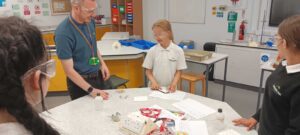
Lansdown Park Academy aims to develop curiosity, confidence, and a positive attitude towards scientific learning, helping students understand the world around them through meaningful, engaging, and practical experiences. Our science curriculum is designed to rebuild learners’ confidence, foster enthusiasm, and encourage them to ask questions, explore ideas, and develop the skills needed to think scientifically.
Students study Biology, Chemistry and Physics within carefully structured cycles that follow the key ideas of the National Curriculum and the CLF curriculum. Lessons include explicit teaching of scientific vocabulary, modelling of key processes, and hands-on investigations to secure understanding. This helps students develop core scientific skills including observing, questioning, predicting, planning, measuring, analysing and evaluating.
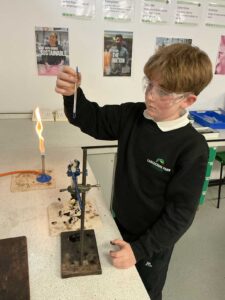
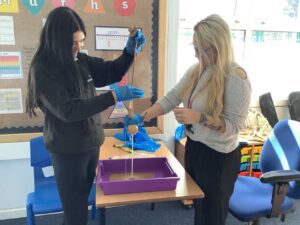
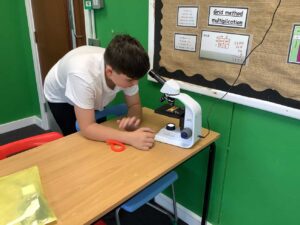
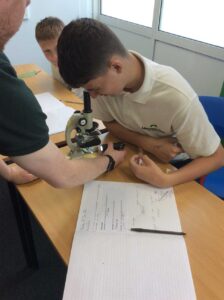
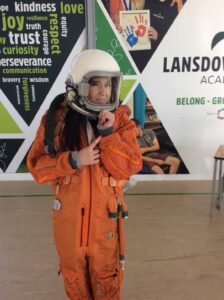
Practical investigation is central to our approach. Students regularly engage in experiments and real-world applications that make abstract scientific ideas accessible and relevant, strengthening motivation and building resilience. This supports learners in experiencing success, whatever their starting point.
Our curriculum is deliberately aligned with mainstream pathways to ensure continuity with what students will study upon reintegration. By following the same overarching concepts – such as cells, particles, forces, interdependence and energy – students gain the foundational knowledge required to progress confidently toward KS4 science.
By giving clear purpose and real-world context to their learning, students understand the value of science for their present lives and their futures. This equips them with the knowledge, skills, and confidence needed for a smooth transition back to mainstream education and for the wider opportunities that lie ahead.
For students following Pathway 2, the science curriculum places a deliberate emphasis on securing the foundational elements of the KS3 curriculum. This pathway is designed to support learners who require additional time and structure to rebuild prior knowledge, confidence and scientific understanding. Teaching prioritises core concepts, essential vocabulary and fundamental practical skills, with learning carefully sequenced to allow for repetition, consolidation and overlearning. By focusing on depth rather than breadth, Pathway 2 enables students to develop secure scientific foundations while remaining aligned with the same overarching concepts as mainstream KS3 science. This ensures coherence, continuity and prepares students for successful progression, reintegration or transition to broader KS3 study when ready.
Students follow a carefully structured science curriculum that builds knowledge and skills progressively from Year 7 to Year 9, while revisiting and strengthening key ideas introduced at KS2. Each module revisits core concepts at increasing levels of depth, allowing students to reconnect with prior learning and secure a foundation that enables success upon reintegration to mainstream education.
Across Biology, Chemistry and Physics, students develop their ability to think scientifically by planning and carrying out investigations, interpreting data, and using evidence to support explanations. Scientific vocabulary is explicitly taught and revisited so that students can speak, write and reason with accuracy and confidence. Practical work forms a central part of implementation, ensuring students experience science as a hands-on, exploratory subject that builds curiosity, confidence and transferable skills.
The curriculum is organised into clear, repeated modules—cells, particles, forces, interdependence, and energy—which grow in complexity from Year 7 to Year 9. For example, students begin with foundational ideas such as cells as the basic unit of life, the particle model of matter, and simple cause-and-effect relationships in ecosystems. This sequencing allows all learners, including those with disrupted educational histories, to rebuild knowledge securely and confidently.
Lessons are directly linked to the National Curriculum and to mainstream schemes ensuring continuity with what students encounter in other settings. This exposure prepares students for smooth transition and supports their ability to re-engage with secondary science learning beyond Lansdown Park. Teaching is adapted to meet individual needs, recognising that students may require shorter task steps, increased modelling, retrieval practice, or scaffolded practical activities.
Literacy and reading are embedded throughout science. Students encounter scientific texts, graphs and diagrams across all modules, learning how to interpret information, extract meaning and use subject-specific terminology effectively. Speaking and listening opportunities are woven into lessons so students can practise articulating explanations, justifying conclusions, and engaging in scientific discussion—skills that support employability and lifelong learning.
Through this approach, students develop a growing understanding of how scientific ideas connect across topics and across years, and how science helps them to make sense of the world around them. By building systematically from KS2 foundations, revisiting core ideas through KS3 cycles, and offering high-quality, accessible scientific experiences, we aim to equip students with the knowledge, confidence and curiosity needed for future success—both in school and beyond.
For students following Pathway 2, science is implemented by a curriculum that prioritises the explicit teaching and consolidation of foundational KS3 knowledge and skills. Lessons are carefully structured to revisit key concepts regularly, with content broken into small, manageable steps and supported through clear modelling, guided practice and scaffolded activities. Scientific vocabulary is explicitly taught and revisited to support comprehension and confidence in communication.
Practical work remains central but is adapted to ensure accessibility, with structured investigations that reinforce core ideas and allow students to experience success. Increased opportunities for retrieval practice, repetition and application support long-term retention and help address gaps in prior learning. Teaching approaches are flexible and responsive, allowing staff to adjust pace, level of challenge and support in line with students’ needs while maintaining alignment with the overarching KS3 curriculum.
Our 12-Week offer will vary depending on when the students arrive, with the content they will study shown in the table below.
| Module | 1 | 2 | 3 | 4 | 5 |
| Topic | Animal and Plant Cells | Chemical and physical changes | Forces | Ecosystems | Conduction, convection and radiation |
| Key Skills |
|
|
|
|
|
| Module | 6 | 7 | 8 | 9 | 10 |
| Topic | Microorganisms | Particle rearrangement | Bodies in space | Interdependence | Light and sound |
| Key Skills |
|
|
|
|
|
| Module | 1 | 2 | 3 | 4 | 5 |
| Topic | Animal and Plant Cells | Chemical and physical changes | Forces | Ecosystems | Conduction, convection and radiation |
| Key Skills |
|
|
|
|
|
| Module | 6 | 7 | 8 | 9 | 10 |
| Topic | Microorganisms | Particle rearrangement | Bodies in space | Interdependence | Light and sound |
| Key Skills |
|
|
|
|
|
The Science curriculum at Lansdown Park Academy empowers students with the knowledge, skills and confidence needed to understand the world around them and to think scientifically about everyday occurrences. Through a carefully sequenced curriculum that revisits and deepens core concepts from KS2 to KS3 and progressively builds from Year 7 foundations toward Year 9 expectations, students develop secure scientific understanding across biology, chemistry and physics.
Students demonstrate increasing confidence when applying the scientific method: making predictions, planning and carrying out investigations, collecting data and evaluating evidence. Their ability to use scientific vocabulary accurately and explain their thinking improves over time, enabling them to communicate ideas clearly in both written and verbal forms. Regular exposure to hands-on practical work helps students develop resilience, problem-solving skills and a curiosity about how systems, materials and processes function in the real world.
As students move through the cycles, they build strong conceptual links and learn to apply prior knowledge in new contexts. This helps them recognise patterns, make connections and develop more sophisticated explanations as their scientific understanding matures.
The curriculum fosters positive engagement by linking learning to real-life applications, careers in science and issues that affect their everyday lives. Students become more motivated, more confident to participate and better able to express scientific ideas with precision. Over time, their improved literacy, reasoning skills and practical confidence support learning across all subjects. Most importantly, students leave Lansdown Park Academy better prepared for reintegration into mainstream education or progression to future study, equipped with a stronger belief in their own capabilities as scientific thinkers. They gain the foundational scientific literacy needed to navigate the modern world, make informed decisions and appreciate the relevance and value of science in their lives and futures.
As a result of the Pathway 2 science curriculum, students develop secure foundational scientific knowledge, improved confidence and positive engagement with learning. Through repeated exposure to core concepts, explicit vocabulary instruction and carefully scaffolded practical experiences, students demonstrate increased retention, accuracy and understanding over time. They become more confident in participating in lessons, explaining their thinking and applying basic scientific ideas to familiar contexts.
Students show improved scientific literacy and practical competence, enabling them to approach science with greater independence and resilience. By securing the essential elements of the KS3 curriculum, Pathway 2 prepares students effectively for progression to broader KS3 study, reintegration into mainstream education or continued success in future learning pathways. Most importantly, students leave with a stronger sense of self-belief as learners and a secure foundation on which further scientific understanding can be built.